
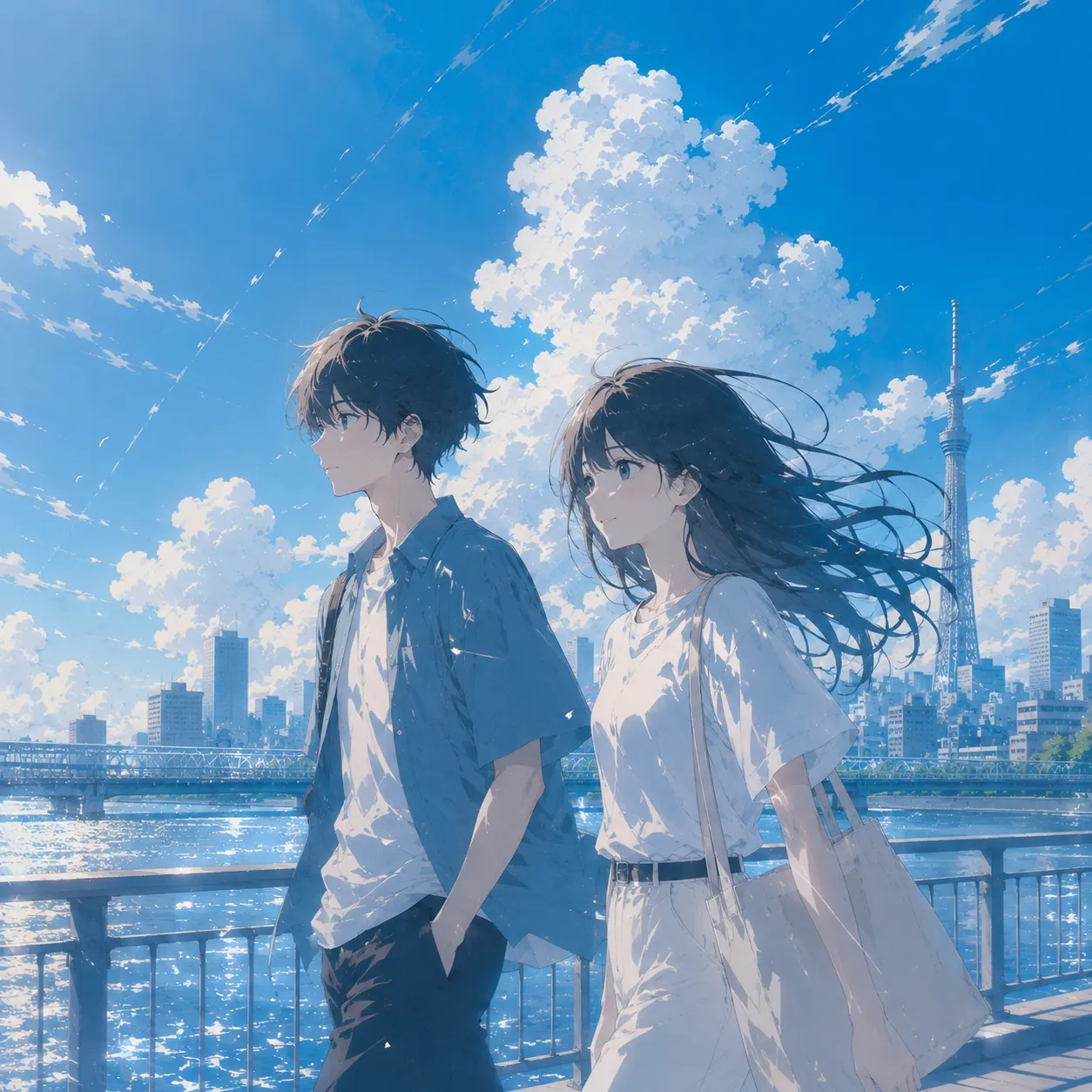
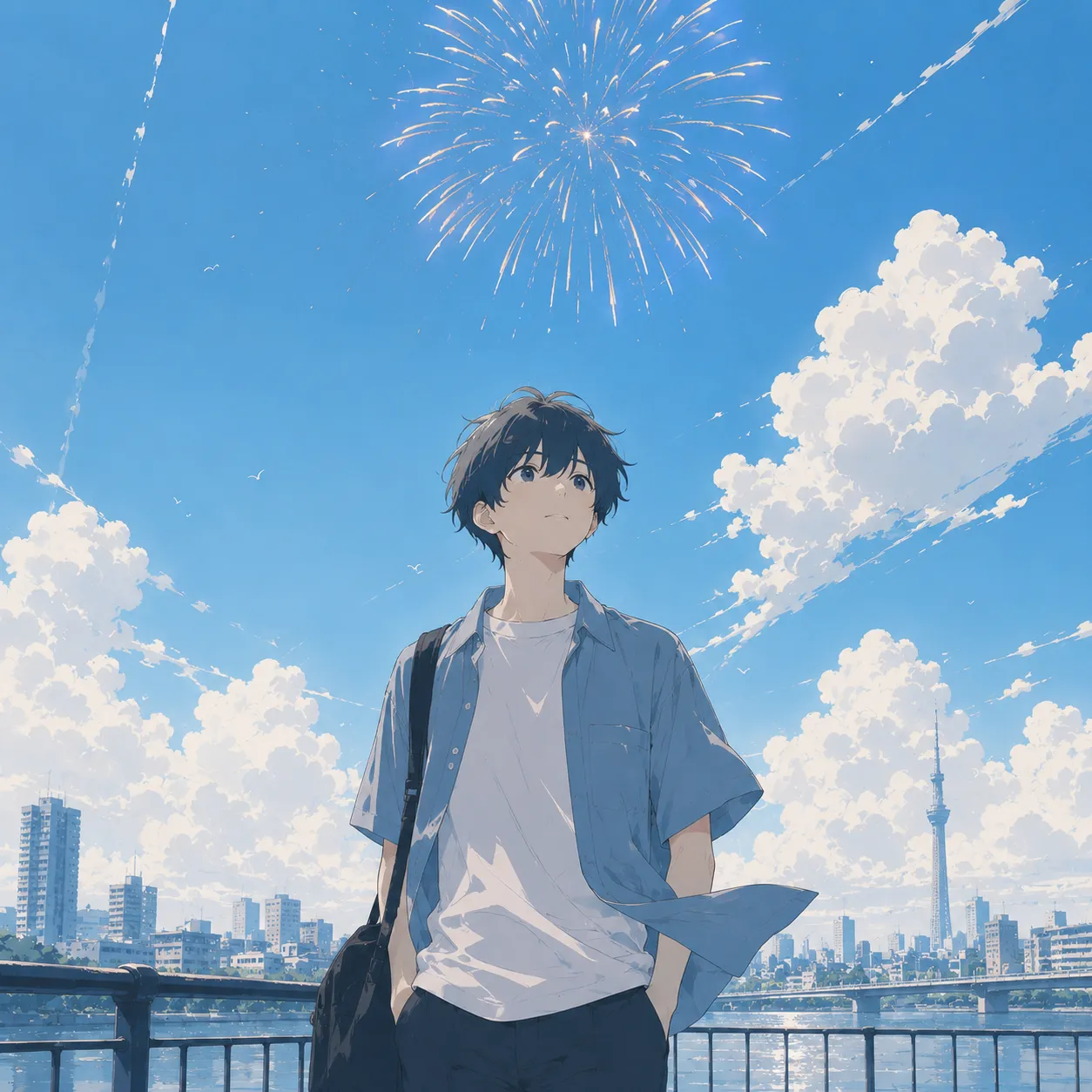
Midday by the Sumida River. A firework opens beyond the towering summer clouds, and its sound arrives a moment later.
“Aozora Hanabi” began with the wish to tell a story about college romance and fireworks. The finished video became more than a summer love story for me. It was also the first time I felt I had finally reached something I had been trying—and failing—to do for a long time: carrying the same characters through an entire music video.
College romance by the Sumida River
The starting point was the TV anime Love Unseen Beneath the Clear Night Sky. Its story of two college students and fireworks inspired me to explore that same combination—college romance and fireworks—through a song and visual story of my own.
That inspiration also led me to the Sumida River as the setting. I did not want to retrace the original story. Instead, I tried to think about how the feeling it gave me could pass through my own perspective and become a different song. This video was made with respect for the original author and everyone involved in the anime, while carrying that spark into my own image of summer.
The light, wind and anticipation in the official teaser trailer stayed with me as well. I wanted to acknowledge where the idea began without simply borrowing what I loved—to let it travel through me and emerge with another emotional direction.
Why daylight instead of night
Fireworks naturally suggest a night sky. I did generate nighttime firework scenes during production. Once I placed the alternatives side by side, however, daylight felt much closer to this song.
Fireworks at night carry the excitement of a festival and the sadness of something ending. Fireworks in a blue sky sit a little outside reality. The landscape is recognizably summer, yet something about it feels impossible. That slight unreality was exactly the kind of image I wanted to explore with AI.
There was simple curiosity in the decision too: would fireworks against a blue sky generate beautifully at all? Would their light disappear, or still read clearly as fireworks? The pale trails against blue and white clouds felt fresher than I expected, and they matched the song’s movement toward what comes next.
Because the project began with an existing work already close to my heart, putting “blue sky” at the center of both the title and the image became an important way to make the idea my own. The night scenes did not make the final cut, but comparing them helped me discover the visual identity of the video.
Finally crossing the character-consistency barrier
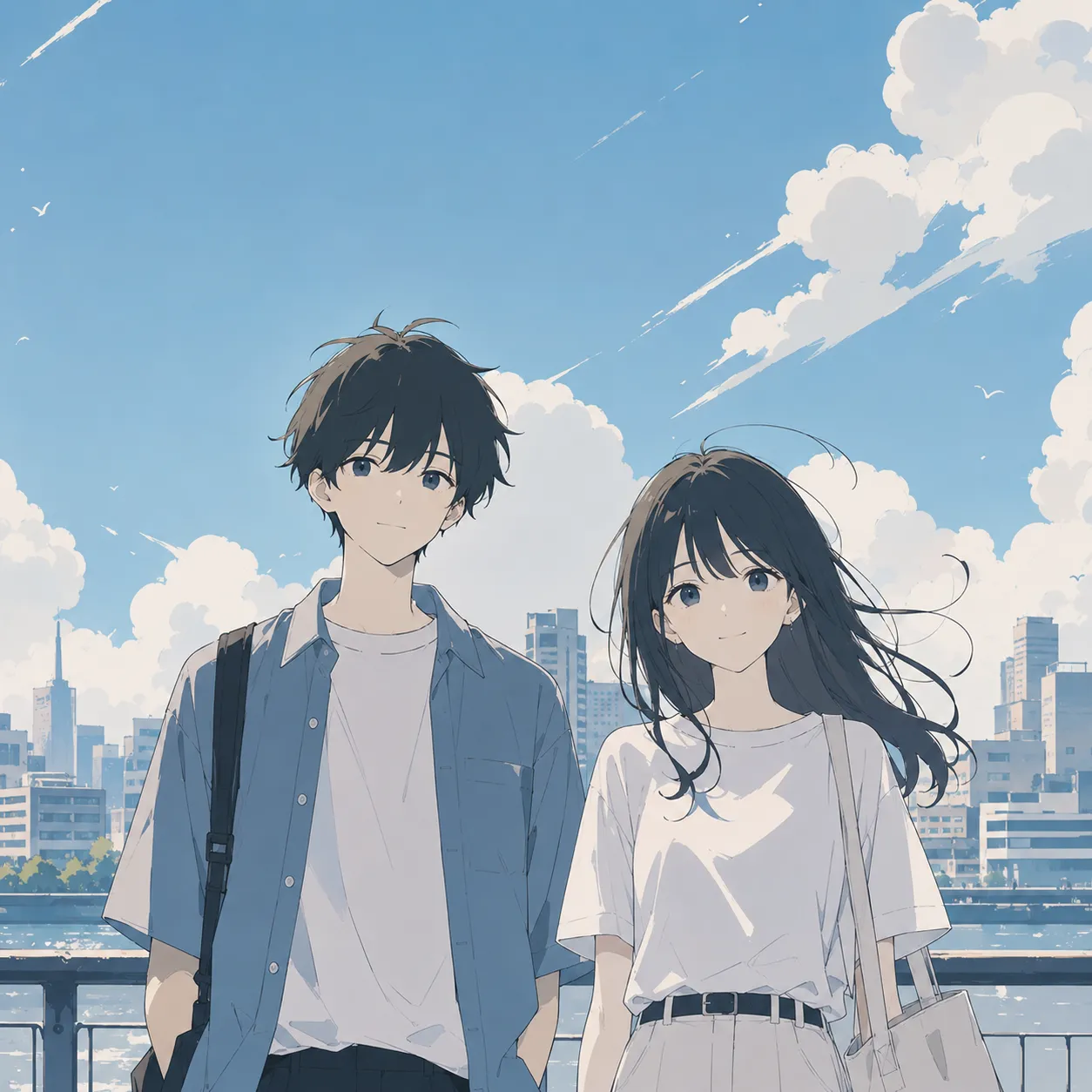
The other reason this work remains so memorable is that it was the first music video in which I felt I had managed to keep the characters consistent.
The same young man and woman walk by the river, appear from another angle, change expressions, and still need to look like themselves. That sounds basic, but across AI-generated shots, faces, hairstyles, clothes and even apparent age can drift very quickly. I had been attempting this since the previous year and failing repeatedly. It had become a personal, almost long-held goal.
In one shot the hairstyle would change; in another, the two characters could even appear to be a different age. A face that looked consistent from the front might become a different person in profile.
When I returned to making music videos after a break, AI tools had advanced. I wondered whether it might finally be possible, and began another trial-and-error attempt. I kept the reference images aligned, narrowed the characters’ clothing and colors, and searched for shots that could change composition without breaking the sense that these were still the same two people.
Viewers will certainly notice moments where a face shifts or a shot makes someone look slightly different. Even so, it felt like a major step at the time.
To be honest, it was not that my own technical ability had suddenly transformed; much of the progress came from better tools. Still, I was genuinely happy to arrive somewhere I had been unable to reach before, even with that help. It felt like crossing a mountain.
Even this summer may become youth remembered
The song’s narrator returns alone to a place the couple walked together the year before. He has not erased the heartbreak, but he no longer follows a stranger who resembles her. When the firework opens, he looks at it through his own eyes this time.
The clear blue sky is not brightness used to cancel out the memory. It is the color of choosing not to hate the dazzling afternoon—or the season they shared—and carrying both forward.
A spark received from a story I admired became the slightly impossible image of fireworks in daylight. In the process, it also helped me move beyond a creative problem that had stopped me for a long time.
More than the finished images alone, “Aozora Hanabi” remains special because it made me think: perhaps I can go a little farther from here.
 drum and bass / indie pop / alternative pop青空花火Open the song page for audio, lyrics, and notes.Explore this song →
Thank you for reading.
← Back to the journal